
There are moments when something inside you constricts.
A comment that feels off. A request that asks too much. A situation that doesn’t sit right.
You notice it for a second. And then you move past it.
You tell yourself it’s not worth getting into. You adjust. You stay composed. You keep things moving.
For many women, this happens often enough that it becomes automatic. Not a conscious decision, but a reflex.
It’s easy to miss how often this happens.
That pause where you could have said something. That feeling you chose not to name. That moment you edited yourself before speaking.
Each one is brief. Almost unnoticeable on its own.
However, your body notices.
Constantly managing your reactions takes effort. Especially when part of that effort involves setting aside how you actually feel.
Over time, that effort adds up. It can show up as irritation that seems out of proportion, or as exhaustion that lingers for too long.
This is often what unexpressed anger looks like over time and the physical cost can be far more significant than most women realize.
The Hidden Burden Women Carry
Women face a unique challenge when it comes to anger. Research shows something troubling: when women experience anger, they don’t just feel the anger itself. They also feel shame and guilt about feeling angry in the first place.
We fear being labeled “bitchy” or “hostile,” while men expressing the same emotion are perceived as “strong” or “assertive.” This double standard creates a painful reality where women’s anger is judged more harshly by society and by ourselves.
According to anger research on gender stereotypes, women who identify with traditional feminine roles tend to:
- Rate anger as less appropriate than men do
- Describe their own anger as more hostile when compared to men’s
- Experience more shame and guilt after expressing anger
- Fear being mocked or criticized by romantic partners for showing anger
This means many women learn early that anger is unsafe, something to hide, minimize, or transform into something more “acceptable.”
Many of us unconsciously or consciously feel that anger is unsafe to experience. Many people who grew up around dysregulated caregivers or adults in a long-term toxic relationship will resist the expression of anger, unconsciously associated with something painful they would never want to participate in.
Unexpressed anger doesn’t vanish. It migrates to the body.

When Suppression Becomes Physical
…three weeks after the conversation you said nothing in.
Your shoulders haven’t dropped. Your jaw aches when you wake up. You snap at your partner over something small, and the force of your reaction surprises even you.
Where did that come from?
It came from the moment you swallowed your words three weeks ago. And the moment before that. And the one before that.
When anger isn’t acknowledged, it doesn’t go away. It gets carried in different ways.
Instead of being expressed, it shows up in the body and in your reactions. You might notice yourself feeling more on edge than usual, or reacting more quickly to things that normally wouldn’t affect you. There can also be a sense of internal pressure, as though you are holding more than the moment requires.
Emotional patterns and physical states are closely connected.
In the body, this may appear as:
- Tightness in the chest or shoulders
- A clenched jaw
- Shallow breathing
- Headaches
- A general sense of tension that remains even when nothing physically demanding is happening
When stress is held in the body over time, it doesn’t simply pass through. It begins to shape how you move through your day, influencing your energy, patience, and overall sense of balance.
How Unexpressed Anger Becomes Chronic Disease
Your body carries what your voice could not say.
Research shows that anger is the most noticeable contributor to chronic pain, regardless of sex or gender. When emotions are not allowed to move through us, they become trapped. People who hold this kind of tension maintain a much higher level of baseline stress.
The medical evidence is sobering, conditions linked to prolonged emotional repression include:
- Autoimmune disorders
- Chronic fatigue syndrome
- Digestive problems and IBS
- Inflammatory conditions
- Persistent pain that has no clear physical cause
The immune system is compromised since the body works much harder when a person rages constantly or holds a lot of emotion back. The person who holds it all in or embraces depression is much more likely to get cancer or some sort of auto-immune disease. (Maté, G. 2003)
The body literally keeps the score. When anger cannot be consciously expressed, it doesn’t disappear, it transforms into physical symptoms.
Scientists measuring the recovery time required for immune system response found that with just 5 minutes of self-generated anger, the body can take up to 6 hours to restore the immune system functioning to normal levels.
Six hours to recover from five minutes of anger.
Now imagine decades of unexpressed anger, carried daily in your shoulders, your jaw, your stomach.
The Childhood Origins of Women’s Health Problems
This pattern typically begins in childhood.
For many women, anger was:
- Dismissed as being “too emotional”
- Punished with withdrawal of love or approval
- Met with consequences that taught us to stay silent
- Modeled poorly by adults who either raged or repressed
Children who witness abuse or violence often hear that someone “got angry” as the explanation for what happened. Naturally, the child rejects the violent episode, but unfortunately, the healthy development of anger gets rejected along with it.
This creates an unconscious association: anger equals danger, harm, or loss of connection.
This is not a weakness. This is adaptation.
But the protective mechanism that kept you safe as a child may now be costing you your voice, your boundaries, and your vitality as an adult.
The Link Between Anger, Stress, and Chronic Illness
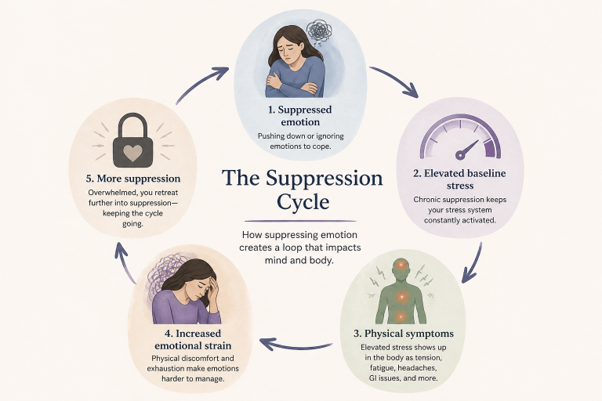
There is a predictable cycle that develops when anger remains unprocessed:
Suppressed emotion → elevated baseline stress → physical symptoms → increased emotional strain → more suppression
We are not responsible for the wounds our bodies carry but we are responsible for how we respond to them.
Many women arrive at our practice asking: “Why does my body hold so much?” They describe feeling perpetually tense, exhausted in ways that sleep doesn’t fix, or experiencing unexplained physical symptoms that doctors struggle to address.
The answer often lies in years of unexpressed emotion living in the nervous system in tight shoulders, clenched jaws, digestive distress, and a body that never fully feels safe enough to rest.
Without awareness and intervention, this cycle continues. But it can be interrupted.
The Emotional Cost → When Boundaries Disappear
When women cannot access anger as a clear signal, several patterns emerge:
Loss of boundaries
Anger serves as the guardian of our boundaries. When we cannot feel it, we struggle to know when a line has been crossed.
We say yes when we mean no.
We tolerate behavior that hurts us.
We stay in situations that drain us.
People-pleasing patterns
Without anger’s protective intelligence, many women become overly accommodating. Harmony becomes more important than honesty. Others’ comfort takes priority over our own needs.
Resentment in relationships
Unexpressed anger doesn’t vanish, it accumulates. It shows up as:
- Passive withdrawal from connection
- Emotional distance that feels confusing
- Sudden reactions that seem disproportionate
- Chronic irritability with no clear source
Difficulty with self-trust
When you consistently override your anger signals, you lose touch with your internal compass. You begin to question your own perceptions and doubt your right to feel what you feel.
“Emotion science considers anger as a primary emotion, part of our navigation system for self-regulation and relationships. The role of anger is to be the guardian of our boundaries. Anger rises when someone transgresses one of your boundaries, to help you defend this boundary.”
Without this guardian, women often find themselves in a painful loop where needs go unvoiced, boundaries remain unclear, and authentic connection becomes impossible.
What Anger Is Actually Showing You
Anger, at its core, is not here to harm you.
When it is welcomed with curiosity, it can become a guide. When you allow yourself to express it honestly, anger often points to what matters to you, where something has been crossed, or where you have been carrying more than you can comfortably hold.
It brings attention to places in your life that need care, clarity, or change.
Think of anger as energy in motion. Like every emotion, it has a beginning, a middle, and an end. Anger exists on a spectrum, from pleasurable states like feeling energized, focused, and determined, to more intense states like frustration, fury, or rage.
Healthy anger serves vital functions:
- It protects your boundaries when they’re violated
- It signals unmet needs that deserve attention
- It provides fuel for action, creativity, and change
- It acts as a doorway to deeper emotional wounds waiting to heal
“Many good things have occurred due to people’s anger. Anger is a part of every major movement in history, whether it is about civil rights, apartheid, racism, or equality. Anger moves people to action.”
The problem is not anger itself. The problem is what we’ve been taught (or not taught) about how to work with it safely and constructively.
When anger begins to move instead of staying stuck, you start feeling more present, less reactive, and more connected to yourself.
These are signs that your body is no longer carrying everything alone.
How to Start Healing Anger
Healing your relationship with anger requires awareness, practice, and often support. Here are essential first steps:
Notice Your Patterns
Where does anger show up in your life? Where does it go underground?
Pay attention to:
- Moments when you feel inexplicably anxious or overwhelmed
- Times when you say yes but feel resentful
- Physical sensations like throat constriction, chest tightness, or stomach tension
- Situations where you go silent instead of speaking up
“We often first notice anger as a tightness in the chest, constriction, discomfort in the belly, heaviness, or pressure in the solar plexus. These are called anger cues. The more connected and aware you are, the more control you have over your responses when anger enters the picture.”

Reconnect with Your Body
Anger often appears physically before it becomes conscious. Practice noticing:
- Your heart rate and breathing patterns
- Areas of tension or constriction
- The felt sense of emotions in your core
This practice, called interoception, helps you catch anger signals early before they escalate or go underground.
Build Capacity in Your Nervous System
You cannot safely process anger when your system feels chronically unsafe. Focus on:
- Lowering your baseline stress through consistent self-care
- Breathing exercises that regulate your autonomic nervous system
- Mindfulness practices that create space between stimulus and response
- Activities that genuinely nourish and restore you
Learn Healthy Expression
A constructive response to anger involves several key elements:
- Self-compassion and empathy rather than harsh self-judgment
- Body awareness to notice anger before it escalates
- Understanding the message beneath the emotion
- Conscious communication that expresses truth without creating harm
- Connection to your heart so you stay grounded in what truly matters
“When you are connected to your heart, you attend to what is essential and what really matters. This healthy response to anger is also about looking at the big picture.”
Additional elements of constructive anger response include:
Treating your anger with respect
- Getting to know your triggers
- Not reacting, getting perspective first
- Choosing not to create drama while maintaining dignity
- Letting anger out in a non-harmful way
You Are Not “Too Much”
Someone once told you your anger was too much.
Too loud. Too intense. Too emotional. Too difficult.
You believed them. You had to, you needed connection more than you needed truth.
But here’s what they didn’t tell you: Your anger was never the problem. Their discomfort with it was.
Your anger is information. It’s intelligence. It’s your body trying to protect you from harm.
And it deserves to be heard.
Allow yourself to feel your anger. Grant it permission to exist. Use its powerful force to transform your reality and bring fuel to your dreams.
The path forward is not about becoming less emotional. It’s about becoming more true, to yourself, your needs, and your boundaries.
When Anger Is Integrated, Your Body Responds
At Healing Anger, we work with women to transform their relationship with anger through a safe, structured, and compassionate process.
Not by suppressing it. Not by acting it out recklessly. By learning to listen to what it’s trying to tell you.
Because when anger is befriended and integrated, profound transformations become possible:
- The body softens as chronic tension releases
- Boundaries become clear and easier to maintain
- Relationships deepen through authentic communication
- Energy returns that was previously bound in suppression
- Self-trust strengthens as you honor your internal signals
- Creative and motivational energy becomes accessible again
“It takes some work (or sometimes a lot of work) to experience anger as a safe emotion. It takes patience, courage, and self-compassion to befriend anger, especially as it has been so discredited, misunderstood, misused, and trashed by our culture.”
This work requires courage. But the freedom on the other side, the freedom to feel fully, protect yourself wisely, and live authentically, is worth every step.

You Don’t Have to Do This Alone
There is something deeply powerful about being in a space where your body’s messages are finally heard.
Where the physical cost of suppression is understood. Where anger can be explored, expressed safely, and gently released from the tissues that have held it for too long.
Healing Anger offers that space for women through supportive groups and counseling. A place where you can begin to understand what your body has been trying to tell you through pain, fatigue, and illness and how to respond in ways that support genuine healing.
Working through patterns of emotional suppression and reactivity can feel overwhelming. Many women try to navigate this journey alone for years before reaching out. Healing happens faster and more sustainably when you have the right support.
The longer unexpressed anger lives in your body, the more damage accumulates. Many women wait years until physical symptoms force them to act. You don’t have to wait for a diagnosis to begin healing.
If you are ready to begin, or even just curious about what that might look like:
- Join our group sessions for women where you’ll find a supportive space to explore anger, triggers, and healthier ways of responding
- Access specialized one-on-one counseling by emailing: info@healinganger.ca
- Call Alistair Moes for a confidential consultation at 604-723-5134
- Visit www.healinganger.ca for more information and resources
The journey from fearing anger to befriending it takes courage. But on the other side lies the freedom to feel fully, speak truthfully, and live as a whole person, no longer fragmented by shame, fear, or suppression.
Your body has been speaking. It’s time to listen.
Your health depends on it.
Book Resources
Proaño, A., & Moes, A. (2024). Healing Anger: Transforming Anger Into Growth. Self-published.
Lerner, H. (2014). The Dance of Anger. HarperCollins Publishers
Levine, P. A. (1997). Waking the Tiger: Healing Trauma. North Atlantic Books
Van der Kolk, B. A. (2014). The Body Keeps the Score. Penguin Books / Viking
Porges, S. W. (2017). The Pocket Guide to the Polyvagal Theory. Vintage Canada / Penguin Random House
Maté, G. (2003). When the Body Says No. Knopf Canada/Vintage Canada/Vermilion